
Interview – Kathleen Verhelst: Why the future of the sector runs through the building trade
The sustainable transition in the construction sector is often viewed through the lens of design, regulation or technology. But according to Kathleen Verhelst, President of Fema and ambassador of Futurebuild Belgium 2026, a crucial lever lies closer to the construction site than is often assumed: the building trade.
“The construction and building materials sector has evolved faster over the past ten years than ever before,” Verhelst explains. Sustainability and digitalisation have dramatically accelerated the pace of change — and will continue to do so. In this context, the role of distributors is expanding. Not merely as followers of trends, but as active translators of change towards contractors, installers and construction companies, both in terms of products and logistics solutions.
From supplier to knowledge partner
Today, distributors operate at a unique crossroads. They are close to execution on site, understand the products, know how they are applied, and are fully aware of the budgetary and planning realities of a project. This makes them ideally positioned to select sustainable solutions, make them visible and provide sound advice.
“The forward-looking distributor is also closely connected to the end user, which makes this role almost a natural extension of their position,” says Verhelst.
At the same time, sustainability cannot remain a theoretical ambition. It must go hand in hand with affordability, reliability, smooth delivery and efficient installation. Many alternatives are still too expensive, overly complex or insufficiently proven. Moreover, the construction sector remains cautious by nature.
“Trust in materials and systems is crucial. People prefer to work with what they know, especially when major investments are at stake.”
Digitalisation supports — but replaces nothing
Digitalisation is having a profound impact on the work of distributors. Data management, traceability, BIM and material passports open up new ways to better support customers. But Verhelst warns against overestimating its role.
“Digitalisation supports the construction value chain, but it will never replace the building trade. No platform can combine local knowledge, advice, service and logistics the way a distributor does.”
At the same time, administrative pressure continues to increase despite good intentions. From supplier to end customer, everyone demands documentation for control and guarantees. This happens in a context where uniform digital standards are still lacking and product data is not always consistent or up to date, leading to inefficiencies and duplicated efforts across the chain. That is precisely why service-oriented process optimisation is becoming a core competence for the building trade of today and tomorrow.
Innovation requires collaboration
According to Verhelst, innovation can only take root sustainably if manufacturers and distributors truly collaborate.
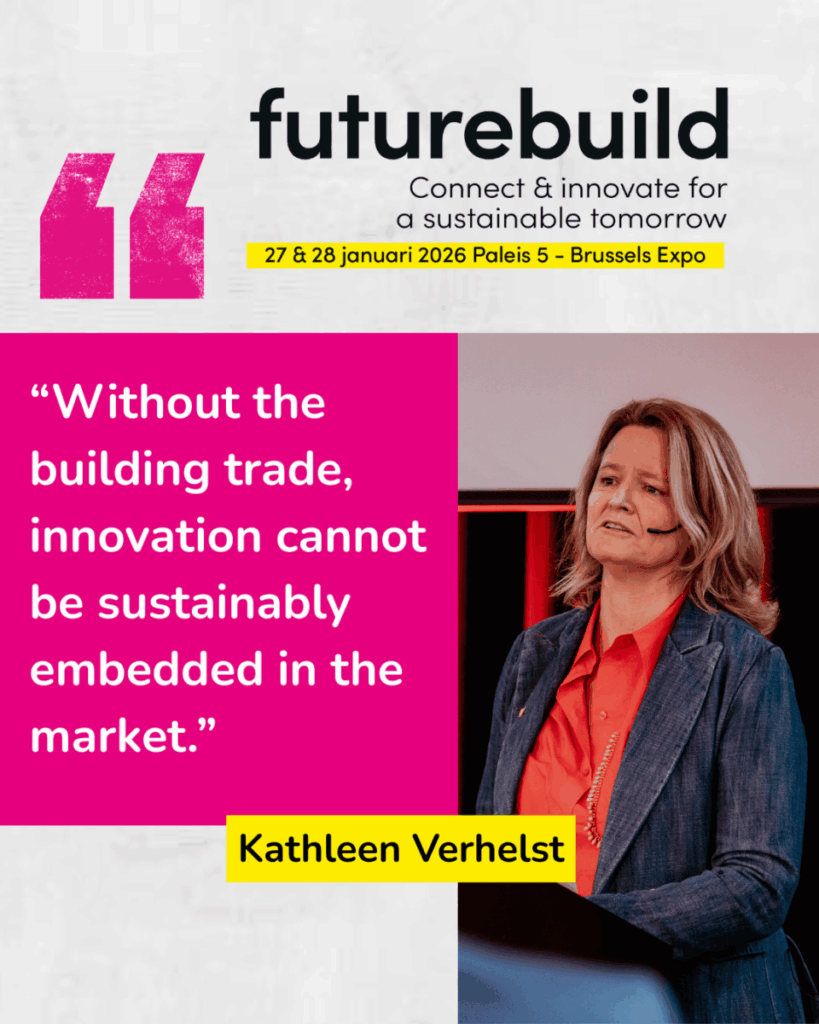
“Too often, the trade is bypassed. As a result, innovation fails to become structurally embedded in the market.”
Manufacturers investing in new solutions must also invest in training, time and a fair business model for their strategic distribution partners. This collaboration becomes even more critical in a challenging economic climate. Price pressure and limited margins are a reality, but efficiency can offset much of that. Smart planning, accurate ordering, waste reduction and digital support ensure that ecology and economy reinforce each other instead of working against one another.
The quiet engine of the value chain
What does Kathleen Verhelst hope visitors will take away from Futurebuild Belgium 2026?
First and foremost, that forward-looking professionals will discover new developments shaping today’s construction world. And that the added value of the building trade becomes more visible and better understood.
“A professional distributor is not a mere intermediary, but a multifaceted partner. They combine technical expertise, logistical know-how and neutrality across a broad product range. That role is essential for a healthy, sustainable construction value chain.”
Her message to fellow distributors is clear and realistic: sustainability is not a hype, but a necessary evolution.
“Those who grow step by step are building a future-proof business. Waiting until everything becomes mandatory is a risk.”